
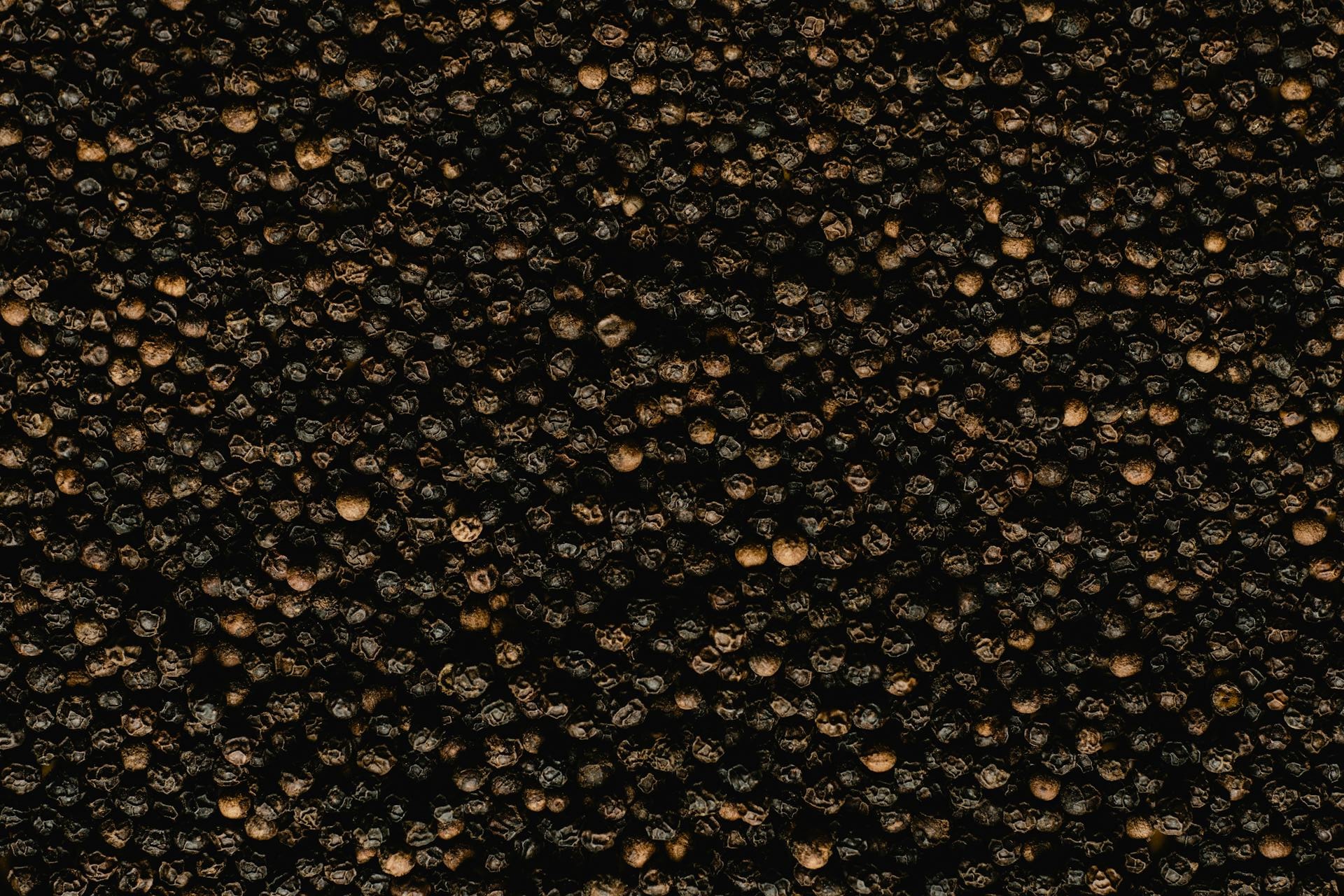
Lampung Province · Piper nigrum L.
Lampong Black Pepper — the black gold of Sumatra.
Lampung has been the epicenter of the 'black gold' trade since the 16th century — monopolized by the VOC through the Banten Sultanate from 1651.
Lampong is the most common black pepper in the UK and accounts for a significant share of US imports — not despite its character, but because of it.
Lada Hitam Lampung registered in Indonesia on 2 May 2016 — protecting the name, the origin, and the tradition.
The Land of Pepper — Forged by Empire
Lampung is not a pepper region by accident. It is a pepper region by history.
The legend holds that pepper arrived in Sumatra from India as far back as 100 BCE, carried by traders who recognized the volcanic soils of the southern tip as perfect growing ground.¹ By the 16th century, Lampung had become the epicenter of the global black pepper trade — so valuable that the Dutch East India Company, working through the Banten Sultanate, monopolized its production entirely. Between 1651 and 1683, every pepper grown in Lampung was required to pass through the sultan's court. When the Dutch annexed the region in 1752, the monopoly simply changed hands.² The pepper kept flowing.
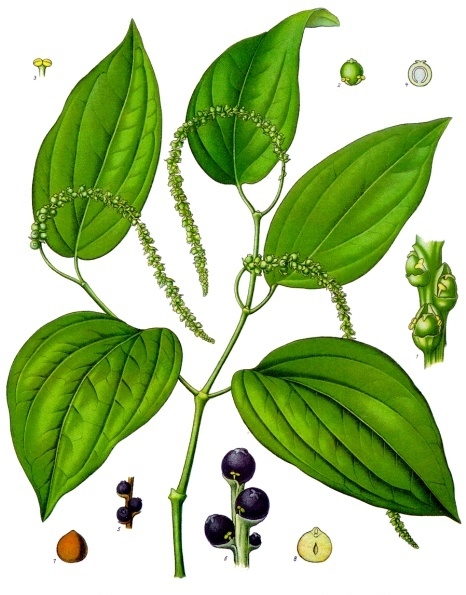
“In the 1930s, Lampung still accounted for 30% of the world's pepper production.”
That dominance was earned by terroir. The volcanic soils of southern Sumatra — dark, mineral-rich, well-drained — give Piper nigrum grown here a density, piperine concentration, and aromatic complexity that spice buyers have returned to for centuries.
Lada Hitam Lampung registered 2 May 2016. Lampong Black Pepper can only bear this name when it originates from Lampung Province, Sumatra — grown, harvested, and processed by this tradition.
Lampung's pepper smallholders operate on thin margins, without the subsidy structures that cushion larger agricultural sectors. Regenerative sourcing models that pay fairly and invest in farm-level quality are not just ethical choices — they are the difference between a living supply chain and a collapsing one.
Sun-Dried. Forged in Heat.
The process that defines Lampong is the opposite of Muntok White. Where Muntok berries are ripe and retting in water, Lampong berries are green and surrendered immediately to the sun.
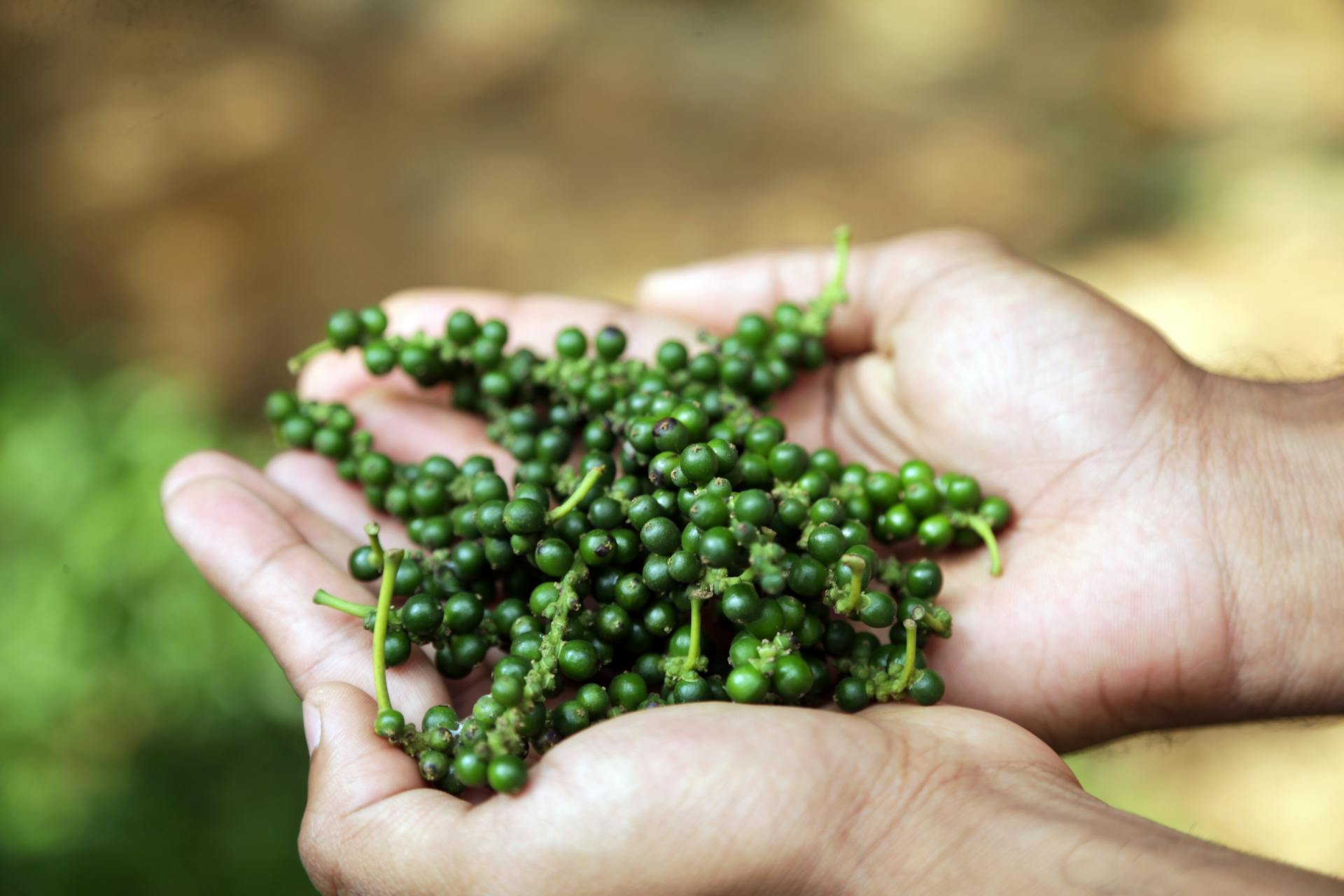 Green berries — harvested before ripe
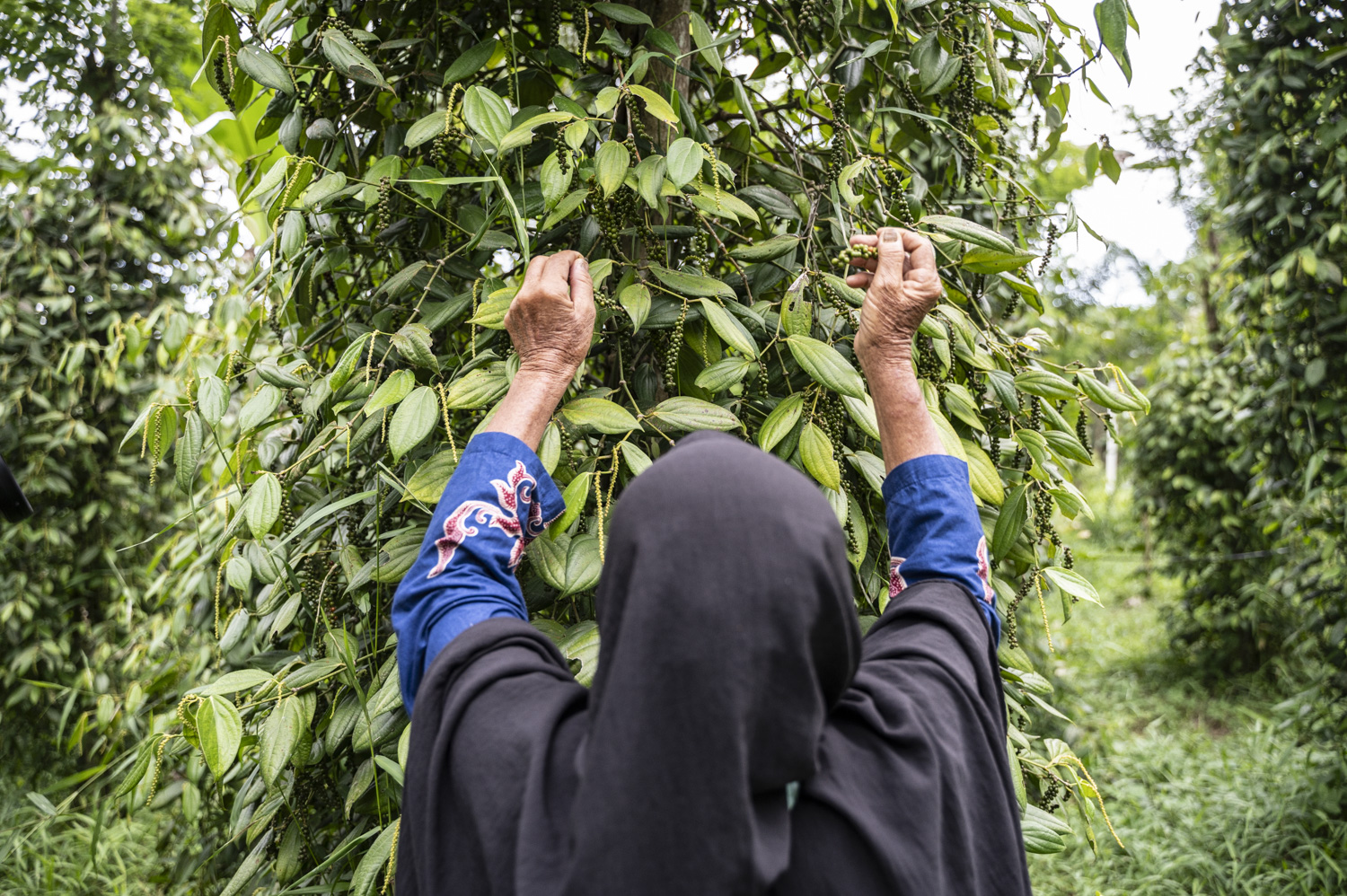 Hand harvest — Lampung, Sumatra
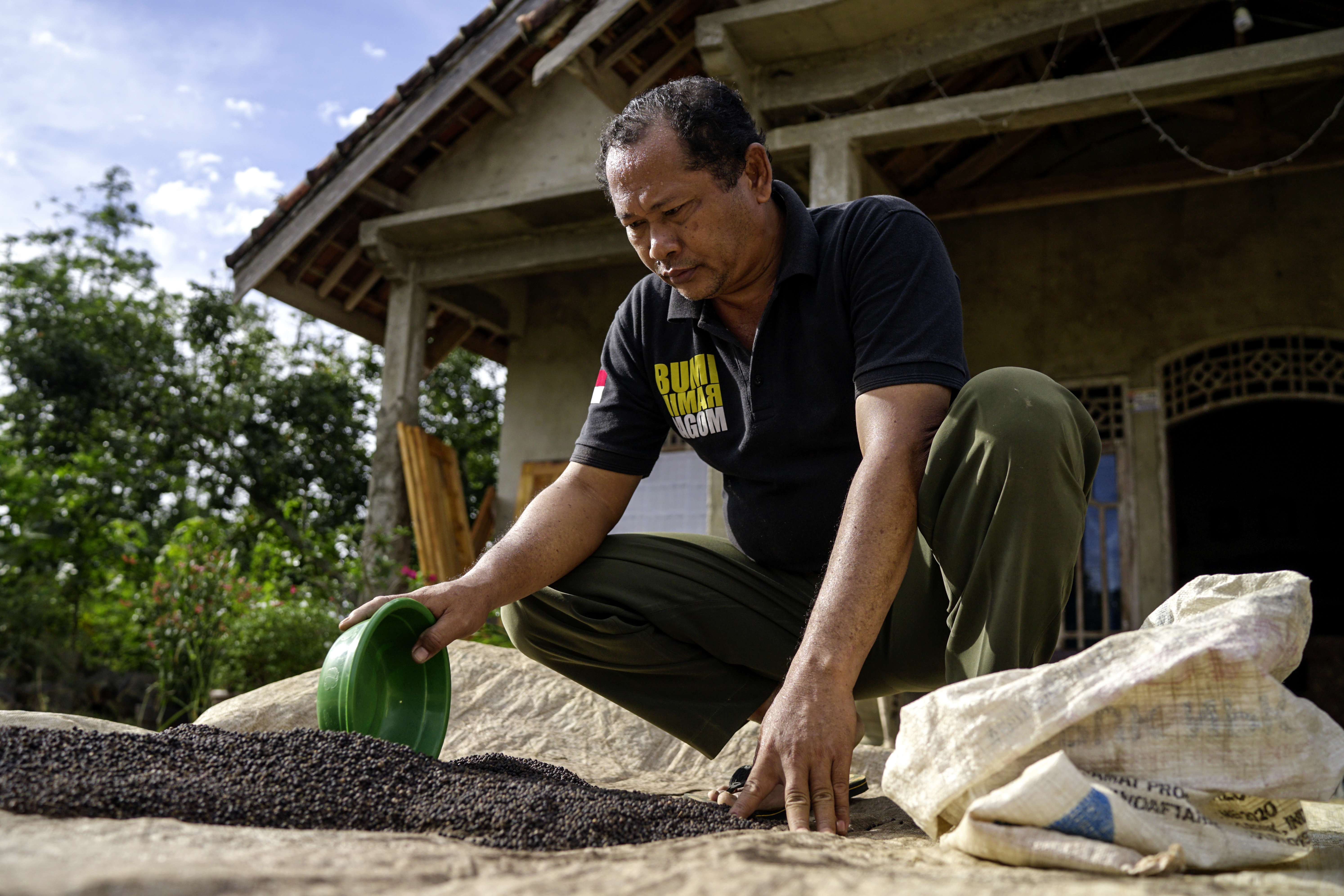 Sun-drying — farmer's courtyard, Lampung
Green or yellow harvest
Lampong peppercorns are harvested while still green or beginning to turn yellow — before full ripeness. This timing preserves maximum volatile oil content in the outer skin, where the most complex aromatics are concentrated. The smaller peppercorn size that distinguishes Lampong from Tellicherry is partly a function of this harvest stage — a quality signal, not a defect.
Sun-drying on woven mats
Freshly harvested berries are spread on woven mats and dried under the intense tropical sun of southern Sumatra. As moisture leaves the fruit, the outer skin shrinks, wrinkles, and hardens — turning a deep, uniform black. This natural drying seals the volatile oils inside the seed, producing the assertive, deeply aromatic profile prized by chefs worldwide.
Sorting and grading
After drying, peppercorns are sorted by hand and screened for density, color uniformity, and foreign material. Bulk density minimum 550 g/L confirms adequate drying and oil retention. The distinctive snap when a Lampong peppercorn is cracked between fingers signals preserved volatile oil integrity.
Steam sterilization — the Cinquer standard
Our specification adds a steam sterilization stage — eliminating E. coli, Salmonella, Bacillus cereus, and Enterobacteriaceae without chemical treatments, and without the heat damage to volatile oils that irradiation causes. Export-grade food safety with fully intact flavor.
Slow Burn. Deep & Woodsy.
Balanced heat with remarkable aromatic complexity — an earthy foundation complemented by subtle pine and floral undertones. An immediate sharp bite, a warm woodsy middle, and a clean, lingering finish.
Penetrating and assertive — woody, earthy, with hints of pine, dried citrus peel, and a faint roasted cocoa note. Opens on cracking and deepens on grinding.
A slow burn. Min 5% piperine builds gradually, peaks, and lingers warmly rather than spiking and fading — exceptionally well-suited to long-cooked dishes.
Tellicherry is a finishing pepper — large, bright, citrus-aromatic. Lampong holds up in long braises, dark glazes, and spice blends where Tellicherry's brightness dissipates.
Signature applications
Steam Sterilized — Export Grade
Traditional Lampong character — deep color, aromatic intensity, dense grain — combined with the food-safety standards required for international food manufacturing and fine dining. It is the specification we sell against, issued per lot to wholesale buyers.
| Parameter | Specification | Why it matters |
|---|---|---|
| Odor | Penetrating, hot, biting pungency | Intensity at rest is the first quality indicator. Weak odor signals age, poor storage, or low volatile oil content. |
| Color | Black | Uniform deep black from natural sun-drying. Inconsistent color indicates mixed harvest maturity or poor processing. |
| Piperine Content | Min 5.0% | Among the highest of any black pepper origin. Confirms harvest quality and oil preservation. |
| Volatile Oil | Min 2.0% | The aromatic complexity that distinguishes Lampong from commodity black pepper. Retained through sun-drying and steam sterilization. |
| Bulk Density | Min 550 g/L | Confirms adequate drying and dense, well-filled berries. Low density indicates under-dried or hollow grain. |
| Activity Water | Max 0.6 | Controls microbial risk and maintains shelf stability during international transit. |
| Foreign Material | Max 1.0% | Strict cleaning standard for export-grade presentation. |
| Moisture Content | Max 12.0% | Prevents mold and preserves volatile oils during storage and transit. |
| E. coli | Absent | Eliminated by steam sterilization without chemical treatment. |
| Salmonella | Absent | Meets international food safety requirements for food manufacturing, restaurant supply, and retail. |
| Yeast and Mold | Max 1,000 CFU/g | Tight control reflecting both low moisture content and steam sterilization. |
| Bacillus cereus | Max 100 CFU/g | More stringent than many competing specs — critical for ready-to-eat and food service applications. |
| Enterobacteriaceae | < 10 CFU/g | Near-zero threshold confirms the effectiveness of the steam sterilization process. |
| Total Plate Count | Max 100,000 CFU/g | Within internationally accepted limits for whole spice. |
Trade & shipping terms
| Term | Detail | What it means for a buyer |
|---|---|---|
| Grade | SS | Steam Sterilised — the export grade we ship. The grade is named on the spec sheet issued with every lot. |
| HS code | 0904.11 | Pepper of the genus Piper, neither crushed nor ground. The heading a customs broker classifies the shipment under. |
| Origin | Lampung, Sumatra | Declared on the certificate of origin as Lampung, Indonesia. Lampong names the province it grew in — the character buyers specify comes with the place. |
| GI registration | Lada Hitam Lampung | Registered in Indonesia on 2 May 2016. GI-certified origin is verifiable against a register, not asserted by a seller. |
| Certification | HACCP · Halal | HACCP food-safety certification and halal certification, held alongside the Geographical Indication above. Copies on request. |
| Sold as | By the metric ton, FCL | Cinquer is an Indonesian pepper exporter supplying wholesale by the full container load, against a quotation. Sample lots on request. |
| Documents | Issued per shipment | Spec sheet — the product datasheet — issued per lot, plus certificate of origin and phytosanitary certificate, travelling with every container. |
| Traceability | Batch record | Each lot carries a batch record traceable plot to port, with the container seal number recorded against it. |
Regenerative Sourcing — Not Just a Label
Cinquer is an Indonesian pepper exporter. We source Lampong Black Pepper through direct partnerships with smallholder farming communities across Lampung Province — traceable to origin, processed to export specification, and priced to give farmers a sustainable return.
Lampung's pepper farmers are the custodians of a 500-year trade legacy. The regenerative agroforestry systems Cinquer supports — integrating pepper with nilam and coffee under the GIZ-backed aGROWforests programme — are designed to make that legacy economically viable for the next generation: diversified income, restored soil, and pepper grown the way it has always grown best: in the ground, in the sun, by hand.
Every kilogram of Lampong sourced through Cinquer is traceable plot to port.
We supply wholesale by the container, against a quotation. Every shipment leaves with its spec sheet, certificate of origin and phytosanitary documents, and the container seal recorded in the batch record. Sample lots on request.
Research References
- 1.Lampong is the most popular pepper in the UK and a major US import. SPICEography ↗
- 2.VOC pepper monopoly through Banten Sultanate 1651–1683; 30% of world production in 1930s. Wikipedia — Lampung Province ↗
- 3.Lada Hitam Lampung registered as GI in Indonesia, 2 May 2016. Geographical Indications in Indonesia ↗
- 4.Lampong flavor profile, earthy complexity vs. Tellicherry citrus notes. spice.alibaba.com, 2026 ↗
- 5.Lampong sharp, somewhat citrusy; most popular pepper in the UK. lacuisineus.com, 2023 ↗